


Channel Five, 7.30 pm,
Thursday 8 th
January 2004
A commentary by David J Tyler
Who am I?” “Why am I me?” “How and why do I think and feel the way I do?” These highly personal big questions provided the theme of Professor Susan Greenfield's programme in “The Big Question” series.
Susan Greenfield is director of the Royal Institution of Great Britain and a specialist in pharmacology. In a nutshell, her answer to the questions in the first paragraph is “the brain”. The brain gives us mind; it gives us emotions; it gives us consciousness. If we were to capture her mental image of the “self” in a diagram, it would look something like this:
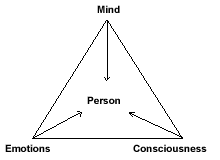 |
We think, we feel and we are self-aware. All these things are possible because we have a remarkable brain. Each of these aspects of brain function were then considered by the presenter.
Discussion of MIND revolved around neuron activity and the forming of connections through life's experiences. The neuronal pattern of everyone is unique because our experiences are unique. Although a link was established between neuronal connections and mind, nothing was said about how the connections lead to rational thoughts or to any other mental process.
Brain activity is also associated with EMOTIONS, but again, almost nothing was said about how observed activity generates the extraordinary range of feelings exhibited by mankind. More was said about Darwin's study of animal emotions, drawing analogies with the human species.
CONSCIOUSNESS was said to be the “hardest problem in biology”. Some research was featured, showing how clusters of neurons can spring into action over very short timescales (a fraction of a second) and this type of activity was said to “merge into the seamless sensation we call consciousness”. Like ripples in a pond, the sensation lingers but is ever-changing. Under the influence of a general anaesthetic, the brain gets less active. There is no centre for this type of behaviour – the brain as a whole is involved. Neuronal firings like this were said to give us the “unique feeling of being alive”. Again, the viewer was left with very little hard science. The collective neuronal firings were linked to consciousness by the presenter, but the evidence for this was missing.
Finally, Susan Greenfield attempted to gather all these thoughts together. How do we arrive at a sense of “me”? She suggested that we could learn something from robots, who are excellent at processing information. But they lack the one vital thing that makes us human – emotions. They do not have any interest in the outcome of their actions. They are not elated with success nor are they sad at failure. People do have a unique integration of mind, emotions and consciousness. The ceaseless activity of our brains is “the very essence of our being”.
* * * * *
The first point that needs to be made about this programme is that the essential links between brain activity and our sense of personhood were not made. At best, we were supplied with some associations between brain activity and human behaviour. The viewer was fed with a conclusion, but not the scientific argument that would lead to the conclusion.
Secondly, the viewer was given no insight into the great gulf that actually exists between the scientific work that is taking place and the answers to the Big Questions that we started with. The answers are just not there. Science provides us with insights into very limited aspects of human behaviour. The nearest we came to an admission of this is that consciousness is the “hardest problem in biology”.
Thirdly, the boundaries of the enquiry into “Why am I me?” were artificially limited by the presenter. What if there is a spiritual dimension to human nature? – how could this ever be known if we start where Susan Greenfield starts? If we assert that everything about humans is a matter of physics, chemistry and the interactions we have with the world around us, how can we ever know that there are non-physical dimensions that are essential to understanding humanity?
By starting with the assumption that human nature can be completely understood in terms of physics and chemistry, Susan Greenfield is making a theological statement. That is, there is no spiritual dimension of reality that is relevant to understanding mankind and myself. This is entirely consistent with the presenter's philosophical position, as she is known as a prominent advocate of humanism in the UK. However, her position is at variance with Christians and others who are not materialists.
According to the revelation of God in the Bible, there is a spiritual realm. God is a spirit. The angels and demons are spirits. Man is unique in the created world in that he is both physical and spiritual. His physical nature is clear from him being made from the dust of the ground; his spiritual nature derives from his being made in God's image. Relationships with other persons are possible because God is personal and we are made in his image. Consciousness is a reality (not an illusion) because we are made in God's image as spiritual beings. Rational thought is possible because we are made in the image of God and he is a rational being. We can appreciate beauty because God is the author of beauty and we are made in his image. We can love others as people (not just because of brain chemistry) because God is the God of love and we are made in his image.
Christians will welcome research into our physical bodies and into the workings of our brains. Our role, however, is likely to be one of injecting a note of realism. Those with materialist ideologies necessarily want to explain the whole of human behaviour and experience of being within the framework of matter being all there is. This will always lead them to claim too much for what science can do – and this is not good for science. Our role is also one of showing that science is not neutral ground for scholars. Scientists bring their presuppositions into their work – as is evident in this presentation from Susan Greenfield. It is not wrong to have presuppositions, but it becomes very wrong when this leads to a closing down of avenues of enquiry and blocking up legitimate ways of developing a scientific discipline. That is why these issues are ultimately of great importance for all who are interested in science and education in our community.
